Mixing Dough
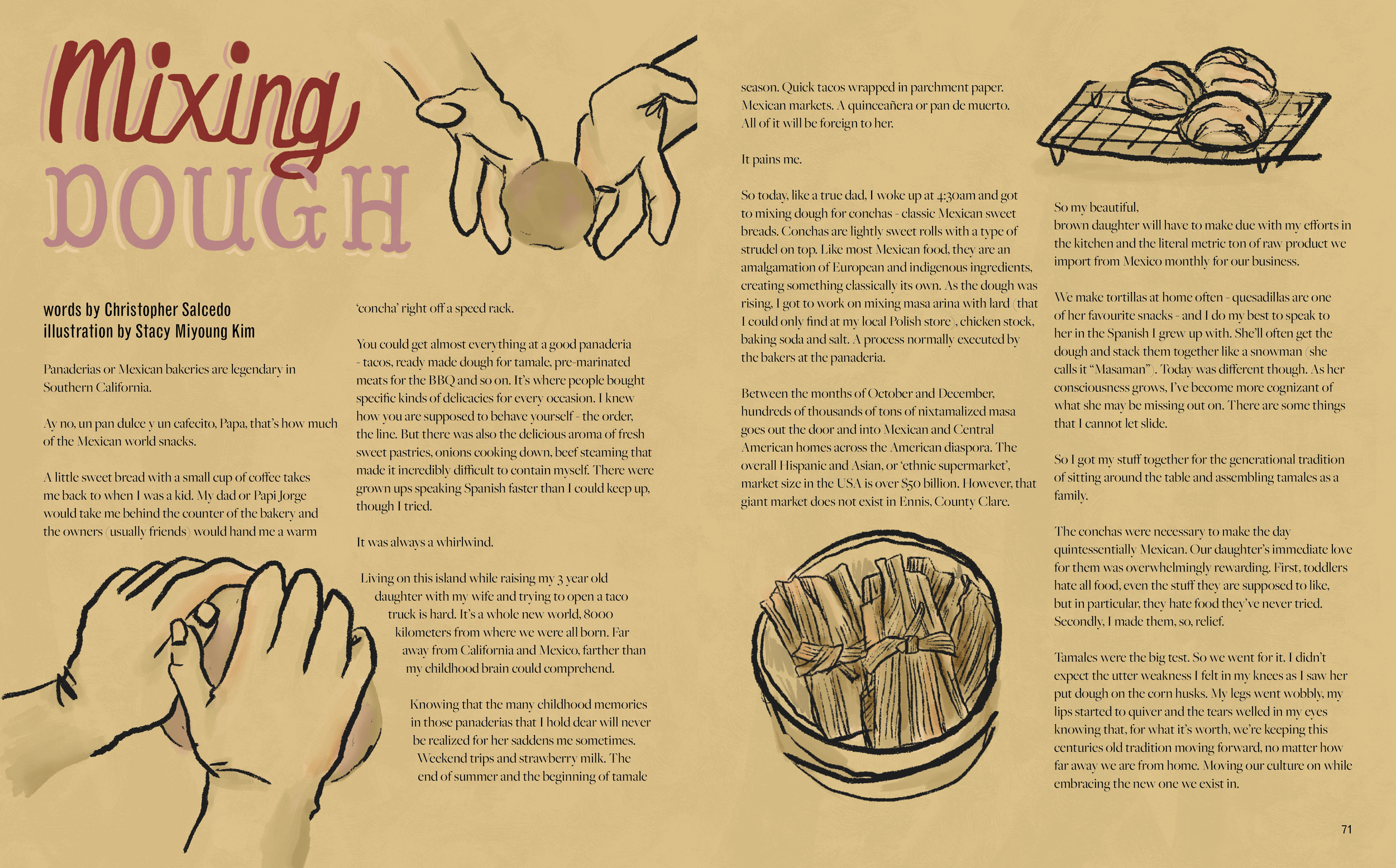
illustration by Stacy Miyoung Kim
words by Christopher Salcedo
for Bia! Zine Issue 02
Panaderias or Mexican bakeries are legendary in Southern California.
Ay no, un pan dulce y un cafecito, Papa, that’s how much of the Mexican world snacks.
A little sweet bread with a small cup of coffee takes me back to when I was a kid. My dad or Papi Jorge would take me behind the counter of the bakery and the owners (usually friends) would hand me a warm ‘concha’ right off a speed rack.
You could get almost everything at a good panaderia - tacos, ready made dough for tamale, pre-marinated meats for the BBQ and so on. It’s where people bought specific kinds of delicacies for every occasion. I knew how you are supposed to behave yourself - the order, the line. But there was also the delicious aroma of fresh sweet pastries, onions cooking down, beef steaming that made it incredibly difficult to contain myself. There were grown ups speaking Spanish faster than I could keep up, though I tried.
It was always a whirlwind.
Living on this island while raising my 3 year old daughter with my wife and trying to open a taco truck is hard. It’s a whole new world, 8000 kilometers from where we were all born. Far away from California and Mexico, farther than my childhood brain could comprehend.
Knowing that the many childhood memories in those panaderias that I hold dear will never be realized for her saddens me sometimes. Weekend trips and strawberry milk. The end of summer and the beginning of tamale season. Quick tacos wrapped in parchment paper. Mexican markets. A quinceañera or pan de muerto. All of it will be foreign to her.
It pains me.
So today, like a true dad, I woke up at 4:30am and got to mixing dough for conchas - classic Mexican sweet breads. Conchas are lightly sweet rolls with a type of strudel on top. Like most Mexican food, they are an amalgamation of European and indigenous ingredients, creating something classically its own. As the dough was rising, I got to work on mixing masa arina with lard (that I could only find at my local Polish store), chicken stock, baking soda and salt. A process normally executed by the bakers at the panaderia.
Between the months of October and December, hundreds of thousands of tons of nixtamalized masa goes out the door and into Mexican and Central American homes across the American diaspora. The overall Hispanic and Asian, or ‘ethnic supermarket’, market size in the USA is over $50 billion. However, that giant market does not exist in Ennis, County Clare.
So my beautiful, brown daughter will have to make due with my efforts in the kitchen and the literal metric ton of raw product we import from Mexico monthly for our business.
We make tortillas at home often - quesadillas are one of her favourite snacks - and I do my best to speak to her in the Spanish I grew up with. She’ll often get the dough and stack them together like a snowman (she calls it “Masaman”). Today was different though. As her consciousness grows, I’ve become more cognizant of what she may be missing out on. There are some things that I cannot let slide.
So I got my stuff together for the generational tradition of sitting around the table and assembling tamales as a family.
The conchas were necessary to make the day quintessentially Mexican. Our daughter’s immediate love for them was overwhelmingly rewarding. First, toddlers hate all food, even the stuff they are supposed to like, but in particular, they hate food they’ve never tried. Secondly, I made them, so, relief.
Tamales were the big test. So we went for it. I didn’t expect the utter weakness I felt in my knees as I saw her put dough on the corn husks. My legs went wobbly, my lips started to quiver and the tears welled in my eyes knowing that, for what it’s worth, we’re keeping this centuries old tradition moving forward, no matter how far away we are from home. Moving our culture on while embracing the new one we exist in.
Tomorrow, I’ll drop my daughter off at the Naoínra Irish immersion school, where she’ll learn a language that is alien to me. It’s difficult for me not to lose myself in thought about how her mindset will be growing up here in Ireland. Growing up as a child of Mexican immigrants in the States was rough, but there were the panaderias, our neighbours, Spanish speakers everywhere and as many taco shops as there are chippers. She won’t have any of that to identify with.
I’ll tell you one thing though, I’m gonna do everything in my power to create those sweet weekend morning memories, fully equipped with conchas and strawberry milk for her. When the days start getting shorter, she’ll start asking about tamales and she won’t know any different. It’s important to remember where you come from, even when you’re looking toward the future. For our family and even possibly our people, food is that vehicle.
Food is the most beautiful and real manifestation of our culture, at least for me it is. I firmly stand on that. It is pure and intimate and it can evoke a deep emotion and connection.
The kind that binds families over continents, oceans, generations and, most paramount, time.